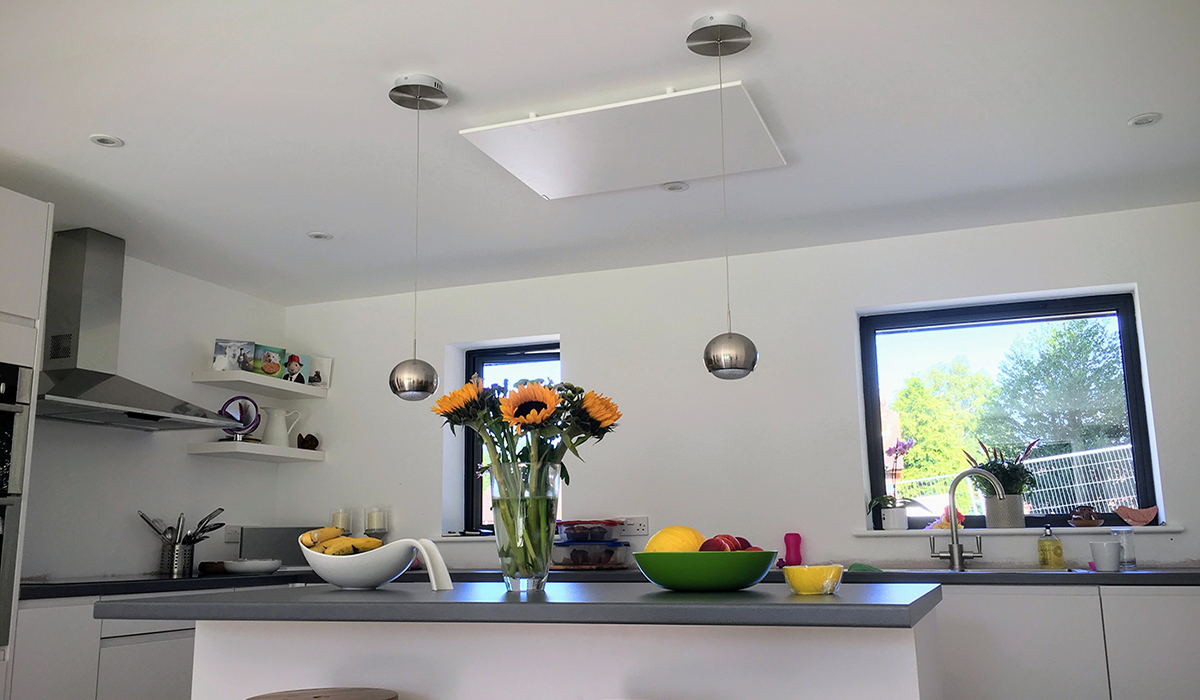
If buildings could talk, they would ask for Infrared

Warming the building, not the air
Herschel infrared heaters work by directly heating the thermal mass of a building, as opposed to heating the air. This means the gentle warmth is absorbed in the building’s floors, walls, and ceilings, and then radiates the heat back out – no more hot air and cold walls.

Reduction of Condensation
Convection heating works by warming the air around the heater, which creates
convection currents that carry the warmth around the room. Warm air has a high capacity to hold moisture and when it meets a cold surface, condensation will occur. This increases the likelihood of mould, wood rot, and salt damp or flaking paintwork.
In contrast, Infrared warms the surfaces of objects without warming the air. The relative humidity in the air remains low and when the air meets a warm surface, condensation does not occur.
This is one of the primary benefits to buildings of Infrared Heating. For similar reasons our heaters are also particularly well suited to use in bathrooms, our mirror and glass towel rail heaters will heat the bathroom whilst reducing the likelihood of damp and mold.
Importance of reducing damp
Damp homes are a health hazard
Old, uninsulated housing is often damp, cold and moldy, which contributes to poor health. Even new housing by being airtight and with little natural airflow can have consequential damp problems causing mold and fungi. Damp homes have been linked to an increased incidence of respiratory illness.
Damp in buildings damages the materials and décor
Damp in buildings damages masonry, causing salt damp in masonry and rot and rust in wood and metal components. Damp in fabrics and decoration causes mold and peeling of wallpaper and paint flaking.
Damp homes cost more to heat
Moisture in a building actually worsens its heat loss. It presents an initial barrier to heat absorption by other materials (by absorbing the heat itself) and via conduction (e.g. wet masonry), leads away heat from surfaces and objects. The good news is that Infrared heating can solve the damp and inefficiency problem.

Reduction of existing damp
Water absorbs heat specifically well at 3 microns and lower which is the range Herschel far infrared heaters operate at. The infrared from the heater will begin to warm the masonry of a building. When masonry is damp, it absorbs and emits infrared poorly and air circulation actually needs to be encouraged to remove the evaporated water vapor. As masonry dries out, the thermal reflectivity of the room also improves. This is because water in damp masonry initially absorbs the heat and does not emit the warmth back into the room, whereas dry masonry re-emits well.
Our infrared heaters help to dry walls and plaster and preserves paintings and fabrics, which makes it particularly useful for preservation of historical buildings.
Infrared heaters such as the Herschel Advantage range can also be used for flood recovery purposes. Far Infrared is better absorbed by the wet masonry over time and dries from the inside out. Hotter heaters such as quartz and gas blowers are less efficient driers, because their harsher heat flash-dries the surface of the wall, creating a “skin” under which bubbles of water vapor then form, causing blistering of the surface of the masonry.

Preserving heritage buildings and artifacts
As infrared gently heats the building and objects directly, this greatly reduces damp levels and helps preserve the structure of the building as well as the artifacts inside.
Hassle-free installation
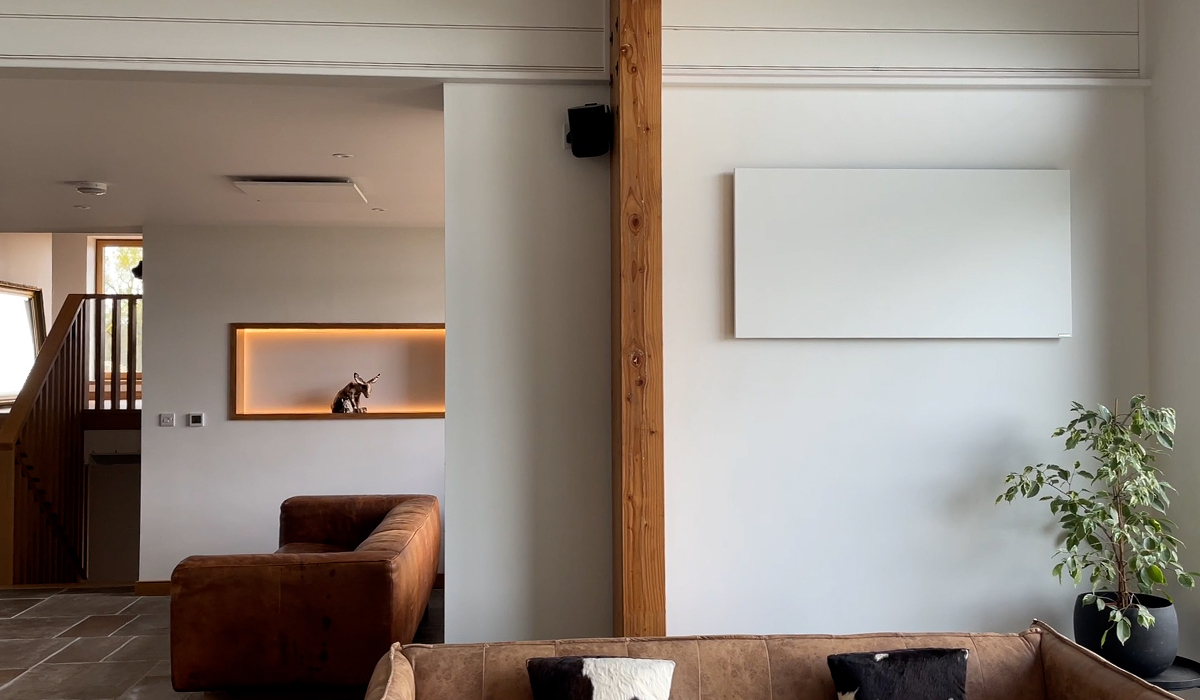
Herschel Infrared heaters are non-intrusive and easy-to-install on both the wall and ceiling. With no shortage of skill required to install them, any qualified electrician will be able to quickly and easily install Herschel heaters.
Watch our explanatory video

Customer Testimonials
“We’re absolutely delighted with all of our infrared heaters”.
We’re absolutely delighted with all of our infrared heaters. We started by installing these into our summerhouse and were so impressed by the glorious heat that they give out that we have started fitting them throughout our entire home.
They’re an ideal solution for our remote property, one that has no vehicle access, and is in a village that does not benefit from gas. So our only solutions were storage heaters or air / ground source heat pumps.
We are delighted with the Herschel heaters that we’ve installed, they are cost effective, easy to install, and allow us to transform our home on a room-by-room basis as opposed to having to find the huge cost of installing some of the alternative systems.
They also have the huge added benefit of preventing condensation, reducing damp and generally being vastly better for your health than typical radiator based heating systems. We absolutely love them.
“Putting into my buy-to-let flats over the last 8 years”
I’m a huge fan of the Herschel Infrared radiators which I’ve been putting into my buy-to-let flats in London over the last 8 years. Whenever one of my gas combi-boilers fails, I immediately look to take the system out, take all those wet water radiators out, all those pipes and all that goes, I put in another form of hot water heating and then the Herschel Infrared radiators. By putting it up on the ceiling it does give more wall space……..the previous radiators often get bumped or draped with clothes by the tenant which is not great as that obviously causes condensation. In the bathroom it’s doing its job well as there’s absolutely no sign of any mould or condensation which is a frequent problem in bathrooms. Once I put one in I’ve been rather keen to put them in everywhere else. Once they are in there is no further cost, I’ve never had a radiator go wrong on me….very easy, very efficient and very good for the environment. It gives a wonderful radiant heat, it’s a very attractive and pleasant environment to live. I think Herschel and their infrared are definitely the way forward.
Frequently Asked Questions
Herschel Infrared panels are easy to install and come with a very comprehensive set of instructions. As Infrared panels are an electric installation, they should only be carried out by a suitably qualified electrician. Herschel has a network of Accredited Installers who would be happy to help you.
Things to consider when planning to install an infrared panel are:
- Provision of a suitably-sized electrical source. If you are unsure, seek your electrician’s advice;
- Locate the panel according to operating heights and minimum separation distances specified in the instruction manual;
- Ensure enough strength exists in the wall / ceiling where you are going to hang the heater;
- Follow any other precautions listed in the instructions.
Installation hardware and guides for measuring and installing the mounting brackets are included in the box with the heaters. Instructions are also always available for download from the website.
This makes Infrared significantly easier to install than oil or gas boilers, heat pumps, underfloor heating etc and implies only minor disruption to your house.
Very occasionally we get asked about decorating problems that show up around heaters and whether the heaters are to blame. However on the rare occasion that we do, in all cases there are underlying problems which the heater – in fact, any heater – is just accelerating or making evident by simple virtue of it doing its job (heating). In all cases, the underlying problem lies elsewhere and will still need to be addressed.
Here are problems we are aware of:
Black marks above the heater
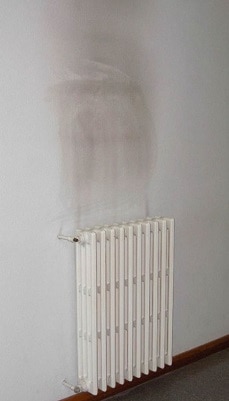 Black marks appearing above a heater is a phenomenon called “Thermal Tracking” or “ghosting”.
This problem, while unsightly, is not caused by the heater, although it is exposed or accelerated by the heater.
The problem is the result of airborne particles, usually in damp environments, clumping together and convecting up behind the heater, before condensing on the colder surfaces above the heaters.
These particles can be anything from soot or fumes from ovens or stoves, candles, cigarettes, log burners, car exhaust fumes from the street or even incense sticks.
In cases where the walls are also damp, the particles can also be due to the formation of mould in paintwork or wallpaper on the warmer thermal “tracks” that exist above the heater.
The problem tends to be worse in draughty houses and damp atmospheres.
How to fix it:
You should seek professional advice from a builder or decorator. However in general the following steps can be taken.
Depending on the surface of the wall, the black marks can be cleaned regularly and this can reduce the unsightliness of the marks but will not remove their cause.
In bad cases, the wall should be thoroughly cleaned and preferably insulated before a non water-based paint is applied to the wall.
Prevent the sources of draughts in the house.
Reduce condensation levels in the house by the use of extractor fans in bathrooms and de-humidifiers in other rooms.
In cases of thermal tracking, moving the heater to a different location in the room may not fix the issue, just move it to another spot.
Peeling Wallpaper
 Wallpaper may peel behind a radiator for any of the following reasons. Like the above problem, the heater is not the cause of the underlying problem, but will certainly expose it very quickly.
Wallpaper which is damp will peel away very quickly, usually starting at the seam of the paper where its adherence will be weakest. Wallpaper can be damp for a number of reasons, chief amongst which is condensation. You should never cover your Herschel Infrared heaters, but clothes placed on other radiators to dry is another common cause of damp wallpaper then cracking around the heater.
Poor surface preparation is another common cause of wallpaper peeling, as the paste is unable to make a proper bond with the surface underneath.
Water-based paste or paste of insufficient strength (wrong mixture) is another reason the wallpaper may peel away under the effects of heat, especially if the room itself is damp.
“Papering over cracks” is a phrase with a negative meaning for a good reason. Cracks that have been papered-over can often still breathe and allow the formation of air pockets and blisters underneath the wallpaper which will lift the paper off the wall.
How to fix it:
You should seek professional advice from a builder or decorator. However in general the following steps can be taken.
Avoid placing the heater over wallpaper seams.
Remove sources of damp and condensation in the room. If the room itself is damp, consider using a de-humidifier to absorb the moisture. In bathrooms be sure to use an extractor fan.
Use PVA adhesive to repair small cases where the wallpaper is lifting.
Seek professional decorating advice if the problem is widespread.
Moving the heater to a different location in the room may reduce or eliminate the problem (e.g placed on plasterboard or better prepared surface).
Condensation
 Electric heaters are not a source of water. (Wet central heating radiators however can be if they leak).
Rooms that are damp, are damp for reasons other than the electric heating.
Applying internal insulation (loft, wall cavities) in your home can increase levels of damp and condensation within the home. Applying external wall insulation tends to decrease levels of damp and condensation.
Infrared heaters have a drying effect on objects because they warm surfaces which tends to discourage condensation and keep the moisture in the air.
However, moist air will still try to condense on cold surfaces unless it is removed, either by extractor fans (in bathrooms), loft vents or de-humidifiers.
Allowing condensation to develop in a room can have many consequences, such as the two problems above, as well as the formation of mould.
How to fix it:
You should seek professional advice from a builder to determine the sources of damp within your home.
If your home is damp, you need to have means to remove damp air, regardless of your heating system. Usually removal of damp air is performed by extractor fans, loft vents and de-humidifiers.
Seek the advice from a professional decorator or builder to remove long term effects of damp in a house (such as mould, wood rot, peeling wallpaper or flaking paint).
Infrared heaters offer a vast number of benefits in terms of efficiency, comfort and practicality. Infrared heating is a low energy, efficient electric heating solution that can be combined with renewables to give you a sustainable heating solution. It is simple to install and is maintenance free, minimising the disruption caused by underfloor heating and avoiding the annual maintenance costs required by heat pumps. Available in a number of stylish finishes, infrared heaters provide a modern and space-saving option whatever the environment and free up valuable floor space. Infrared heating is also widely recognised for delivering improved comfort levels, with a natural and fresh feeling of heat rather than the stuffy heat that alternative heating solutions can often create. Infrared heating is also great for buildings as it maintains a higher temperature in the material of the building, reducing the causes of moisture and minimises condensation, damp and mould.
No, there is no risk of damage from the Halo. The radiant wavelength is similar to that which humans radiate, and the measurable surface temperatures are no greater than they would be through human contact. The feeling of heat is similar to that of the heat of the sun through a window and there is no additional risk of differential expansion than that. (Conversely, this has previously been a risk from using quartz ray/near IR type heaters and is also true of radiators).