
We are the Global Infrared Experts and are here to help
You will find answers to our most frequently asked questions about infrared heating below.
If you cannot find the answer you are looking for here, please use the Chat during working hours and one of our experts will answer your question directly. Out of hours, or if you prefer, also check our site on How Herschel Infrared works or Contact Us if you have any other questions.
"Where can I...?"
Outdoor heaters are becoming increasingly popular, but there are many different types of heater available and lots of jargon.
Even on the nicest of days it can often get chilly or cold in the evening and if you want to enjoy socialising outside, outdoor heating is a must.
So we’ve put this handy guide together to help you chose the right heater for you and answer the most commonly asked questions.
Herschel Infrared Heaters are available for purchase across the USA & Canada with 10 to 14 days delivery for most items when in stock. All our heaters, thermostats, and accessories can be used in most applications and commercial spaces. The following heaters have UL or ETL certification (additional information can be found on each product page):
Herschel Comfort White / Color / Ceiling Tile Heater / Portable
Quality & Safety
There have been a number of low voltage, very thin, carbon based heating products in the form of “Wallpaper”, in-wall, ceiling or underfloor mats that have recently appeared on the market promoting themselves as “Infrared”, “far infrared” and / or “Radiant” heating technologies. Typically these systems are low voltage (via transformers) heat mats which can be installed to cover a large area within walls, ceilings and floors.
These heating systems reach a maximum of 40°C surface temperature and are usually much cooler once covered with plaster, carpet, paint etc. For the reasons explained below, these systems usually demonstrate a relatively low percentage of radiant (infrared) heat, with most of the heat energy being in the form of convection and conduction. It is therefore misleading to make claims of these systems as being “Infrared” or “Radiant” heating solutions and they cannot be classified as radiant (infrared) heating systems under UK and international electrical standards.
To have radiant (infrared) heat, you must have a distinct temperature difference between the heater and the things it is trying to heat. The following diagram shows the difference in radiated energy between 3 objects: one at 25°C (roughly surface temperature of human skin); 50°C (i.e. central heating radiator) and one at 100°C (i.e. Infrared Heating panel).
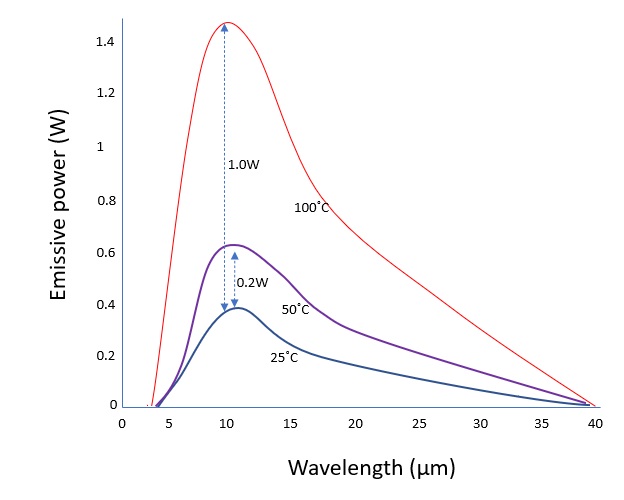 You can see from the diagram that the radiant heat transfer between something at 50°C and another at 25°C is very small: around 0.2 watts per meter. This is barely discernible on the skin as radiant heat and you can easily test this yourself by moving your bare arm closer and closer to a central heating radiator until you can sense the heat. (You almost have to touch it).
Contrast this with an Infrared panel at 100°C and an object at 25°C where the heat transfer is about 1 watt per meter and easily discernible on the skin up to a couple of meters away from the panel.
At 40C and only 0.004 watts per cm2, the emissive IR properties of “Infrared Wallpaper” will be negligible. All the wallpaper is doing is slowing down the rate of heat loss by conduction from the walls and ceilings (indeed suppliers urge you not to place it on outside walls at all). Otherwise it is just warming the air in the room. We don’t dismiss that this might be effective in some way if you cover enough of your walls and ceilings with it. However, at 40°C and 0.004w/cm2 Electric Infrared Wallpaper cannot claim to be radiant (or Infrared) and claim the benefits that infrared heating has over convection.
The international (IEC) standard for performance of household radiators actually considers heated wallpapers (or any heater at or below 40°C) as out of scope for radiant performance assessment. This is for the reasons described above and shown very clearly by the diagram: there is too little transmissiveness of radiant heat as a proportion of the total power consumption to allow the heaters to claim they are radiant (as opposed to convective or conductive).
IG Infrared https://www.ig-infrared.com/en/home.html is the EU Infrared manufacturers trade association and defines infrared heaters as requiring a minimum surface temperature of 75°C and a minimum watts coverage over the panel surface of 0.09w/cm2 to qualify as “Infrared Heaters” (wallpaper watts coverage is 0.004w/cm2).
We have had a number of customers who have installed this type of heating say it has not lived up to expectations and have switched to our infrared heating panels.
Our panels are tested and verified by the German research establishment TÜV and the tests include verification (Geprufte Sicherheit – or “Proven Safety and Health”) and Electromagnetic compatibility with current world standards for human health and electrical appliances. They are also RoHS and REACH and EcoDesign (Lot 20) Compliant.
Click here for more detailed information.
Are Infrared rays safe for people?
 Far infrared heating is 100% safe and natural for our bodies, and our well-being, as the human body is designed to accept and emit infrared. The feeling of warmth from infrared is particularly comfortable. It is UV that is harmful, not infrared, and so there is no need to worry.
 The water in our skin responds well to this particular wavelength of heat which is why it is also called the “Vital Range” of heat. This is why Infrared heaters feel so comfortable. Far Infrared rays are the same heat you would feel off a sandy beach or rocks warmed up in the sun.
People feeling an infrared heater for the first time say it is like walking past a window that the sun is shining through.
Is Infrared harmful at all?
 The International Commission for Non-Ionising Radiation Protection (ICNIRP) has conducted numerous investigations into the health effects of different types of Infrared and is the resource that national bodies like the UK Health & Safety Executive refer to when setting safe working conditions. The ICNIRP concludes that for known artificial sources of Far Infrared, the “contribution made by the IR-C spectral region 3-1000µ is normally of no practical concern from a health hazard standpoint”.
Do Infrared heaters emit Ultraviolet? Are there any health risks?
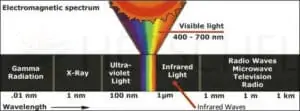 Although often compared to the “heat of the sun” Far Infrared panels do not emit ultraviolet. Ultraviolet is on the “high energy” side of the Electromagnetic spectrum and is associated with the harmful effects of exposure to the sun. At the opposite end of the spectrum, infrared is on the “low energy” side of the Electromagnetic spectrum and does not have any of the harmful characteristics of Ultraviolet. Far infrared, the gentlest form of infrared, is often used in incubators for babies.
Do infrared panels emit EMF (Electromagnetic Fields)?
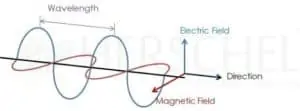 Although the Infrared is generated electrically, all Herschel Infrared panels are also tested during certification and certified as “Low Electrosmog” appliances, falling within the lowest category of EMF output . They are also certified as having no radio interference or interference with other control devices (like remote controls) that use IR.
All electronic devices emit electro-magnetic fields in varying levels and collectively this effect is referred-to as “Electrosmog”.
All devices are therefore also subject to regulations governing the amount of acceptable EMF they can produce and reputable manufacturers in Europe are required to adhere to those regulations as part of their CE declaration.
Herschel products operate well within current safety guidelines and standards relating to EMF.
Herschel is also satisfied these standards are regularly scrutinised and updated in light of new research findings in developing technologies, best practice in the industry and legal requirements of health and safety.
Are Infrared Panels Safe to touch?
There is a risk of injury from touching any form of heater and Herschel infrared panels are no different. However, a key benefit of Herschel panels, unlike conventional heaters, is that they can be mounted higher up on walls or ceilings – reducing the likelihood of accidentally touching them or falling against them. We always advise this, especially in areas where young children or the elderly are present.
Our Herschel Inspire panel heaters (excluding our Herschel IR space heating range; Advantage IRP4, Aspect XL etc) have surface temperatures of 185 – 203 degrees Fahrenheit. If you do touch one of these panels you will perceive this as hot on initial contact but, provided you do not continue to touch the panel, are unlikely to scald or burn.
The reason that you can touch Herschel panels without immediately injuring yourself is because a Herschel infrared panel typically has a heat energy or “watt density” of 0.58 watts per inch² – an energy level that the skin can absorb and conduct away from the area of contact.
It is not the temperature that does the damage but the heat energy in the object.
A kettle, for example, typically has a watt density of between 95 – 195 watts per inch². The skin cannot absorb and conduct away this level of energy and consequently scalds on the area of contact. Yet, both the Herschel IR panel and the kettle are close to 210°F.
Warning: Please note that prolonged contact with any heater, Herschel included, will result in injury. Please also note that the Herschel IR space heating range (Advantage IRP4, Aspect XL etc) all utilise elements which run at far higher temperatures and would cause immediate injury if touched. These heaters must always be mounted in accordance with our instructions & never be touched when switched on or for 30 minutes after use.
Herschel Infrared panels come with a 10 year guarantee. Our Inspire range is designed to last decades because of the high quality of materials and advanced heating elements that are used. Herschel Far Infrared panel heaters require no maintenance or servicing. Our heaters use solid state elements unlike water-based heating or fan-assisted systems, which often require servicing, inspection and repair costs. And unlike gas or oil boilers you won’t have to contemplate performing an entire re-installation every 10 years.
Herschel Infrared heaters and control products are certified to national safety standards.
Longest track record
Herschel have the most extensive experience of the application of Far Infrared in the UK (check our case study page). Effective heating is all about matching the right heater to the right requirement and we have many years experience in this: helping us develop not only our estimating models, but also driving product development too.

Best heaters and widest choice and quality
Herschel has developed heaters to provide the best combination of quality, performance and price available. We have the largest range of heaters available for the widest range of applications. All of our heaters have been extensively tested to UK and International standards and carry best in class warranties. We are the only UK Far Infrared specialist to provide and insist upon full training and accreditation for our installers, distributors and re-sellers.
Integrity
Integrity is one of our core values and we will never allow our heaters to be mis-specified or mis-sold. You can be sure that when you purchase a Herschel heater you will be purchasing the right heater for the right application and will have many happy years of use. Key benefits:
- Quick and reliable delivery across North America;
- No need to register your warranty if you buy direct from us;
- No quibbles replacement of qualifying warranty claims;
- Access to Herschel technical support.
Please also see FAQs on What quality standards are Herschel panels tested to? and Are there any standards on Far Infrared panel performance?
The European Far Infrared Panel Standard is:
A flat surface panel with a surface temperature of 167°F or higher.
An emission rate of least 0.58 watts per inch2 over the panel surface.
Must have CE, Electrical Safety, Electrical Emissions, Safe Construction and Intelligent Controls certification.
These requirements are necessary to protect customers by standardising the specification and performance of Far Infrared heaters and meet critical construction, electrical safety and performance standards.
Please also refer to the FAQ on What quality standards are Herschel panels tested to?
Installation Questions
To allow the panels to operate at the right temperature and unobstructed, our Instructions call for no objects to be placed within 16 inches of the front of the panel and not within 8 inches of the sides of the panel. This includes if you are intending to flush-mount panels in a plastered ceiling where you must still leave 8 inches around the sides of the panel which is necessary to allow you to mount or dismount the panel easily, but ensures the panel will operate at the correct temperature. The limitation does not apply to heaters being placed in a ceiling grid where the heater has to fit into the grid and therefore touch the structure of the grid. However we would still advise you not to place two heaters next to each other in a grid.
However, in practical terms, you don’t want to position a far infrared panel where objects and furniture will obstruct their radiant effect. Panels should be sited to maximise the throw and spread of the far infrared heat without obstruction. The panels radiate heat in all directions and any obstructions will interfere with the performance of the panels. Furniture should not be placed directly in the path of the panel. For example, if the panel was sited on a wall ABOVE a sofa this would warm the room and the sofa and would be working effectively, However, if the panel was located low down behind the sofa, the panel would heat the back of the sofa and not the room and would NOT work effectively. This is very different to conventional “radiators” which heat the air and are often sited behind furniture.
For our more powerful space heaters, please consult the instructions, as distances vary with each heater. We also advise that it should not be possible for materials such as curtains to blow onto the space heaters and to adhere to the minimum mounting heights of these units recommended in the instructions.
Very occasionally we get asked about decorating problems that show up around heaters and whether the heaters are to blame. However on the rare occasion that we do, in all cases there are underlying problems which the heater – in fact, any heater – is just accelerating or making evident by simple virtue of it doing its job (heating). In all cases, the underlying problem lies elsewhere and will still need to be addressed.
Here are problems we are aware of:
Black marks above the heater
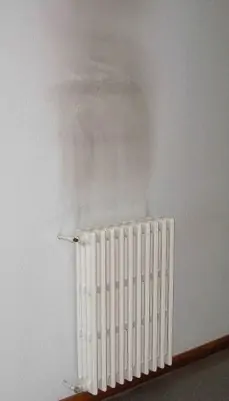 Black marks appearing above a heater is a phenomenon called “Thermal Tracking” or “ghosting”.
This problem, while unsightly, is not caused by the heater, although it is exposed or accelerated by the heater.
The problem is the result of airborne particles, usually in damp environments, clumping together and convecting up behind the heater, before condensing on the colder surfaces above the heaters.
These particles can be anything from soot or fumes from ovens or stoves, candles, cigarettes, log burners, car exhaust fumes from the street or even incense sticks.
In cases where the walls are also damp, the particles can also be due to the formation of mould in paintwork or wallpaper on the warmer thermal “tracks” that exist above the heater.
The problem tends to be worse in draughty houses and damp atmospheres.
How to fix it:
You should seek professional advice from a builder or decorator. However in general the following steps can be taken.
Depending on the surface of the wall, the black marks can be cleaned regularly and this can reduce the unsightliness of the marks but will not remove their cause.
In bad cases, the wall should be thoroughly cleaned and preferably insulated before a non water-based paint is applied to the wall.
Prevent the sources of draughts in the house.
Reduce condensation levels in the house by the use of extractor fans in bathrooms and de-humidifiers in other rooms.
In cases of thermal tracking, moving the heater to a different location in the room may not fix the issue, just move it to another spot.
Peeling Wallpaper
 Wallpaper may peel behind a radiator for any of the following reasons. Like the above problem, the heater is not the cause of the underlying problem, but will certainly expose it very quickly.
Wallpaper which is damp will peel away very quickly, usually starting at the seam of the paper where its adherence will be weakest. Wallpaper can be damp for a number of reasons, chief amongst which is condensation. You should never cover your Herschel Infrared heaters, but clothes placed on other radiators to dry is another common cause of damp wallpaper then cracking around the heater.
Poor surface preparation is another common cause of wallpaper peeling, as the paste is unable to make a proper bond with the surface underneath.
Water-based paste or paste of insufficient strength (wrong mixture) is another reason the wallpaper may peel away under the effects of heat, especially if the room itself is damp.
“Papering over cracks” is a phrase with a negative meaning for a good reason. Cracks that have been papered-over can often still breathe and allow the formation of air pockets and blisters underneath the wallpaper which will lift the paper off the wall.
How to fix it:
You should seek professional advice from a builder or decorator. However in general the following steps can be taken.
Avoid placing the heater over wallpaper seams.
Remove sources of damp and condensation in the room. If the room itself is damp, consider using a de-humidifier to absorb the moisture. In bathrooms be sure to use an extractor fan.
Use PVA adhesive to repair small cases where the wallpaper is lifting.
Seek professional decorating advice if the problem is widespread.
Moving the heater to a different location in the room may reduce or eliminate the problem (e.g placed on plasterboard or better prepared surface).
Condensation
 Electric heaters are not a source of water. (Wet central heating radiators however can be if they leak).
Rooms that are damp, are damp for reasons other than the electric heating.
Applying internal insulation (loft, wall cavities) in your home can increase levels of damp and condensation within the home. Applying external wall insulation tends to decrease levels of damp and condensation.
Infrared heaters have a drying effect on objects because they warm surfaces which tends to discourage condensation and keep the moisture in the air.
However, moist air will still try to condense on cold surfaces unless it is removed, either by extractor fans (in bathrooms), loft vents or de-humidifiers.
Allowing condensation to develop in a room can have many consequences, such as the two problems above, as well as the formation of mould.
How to fix it:
You should seek professional advice from a builder to determine the sources of damp within your home.
If your home is damp, you need to have means to remove damp air, regardless of your heating system. Usually removal of damp air is performed by extractor fans, loft vents and de-humidifiers.
Seek the advice from a professional decorator or builder to remove long term effects of damp in a house (such as mould, wood rot, peeling wallpaper or flaking paint).
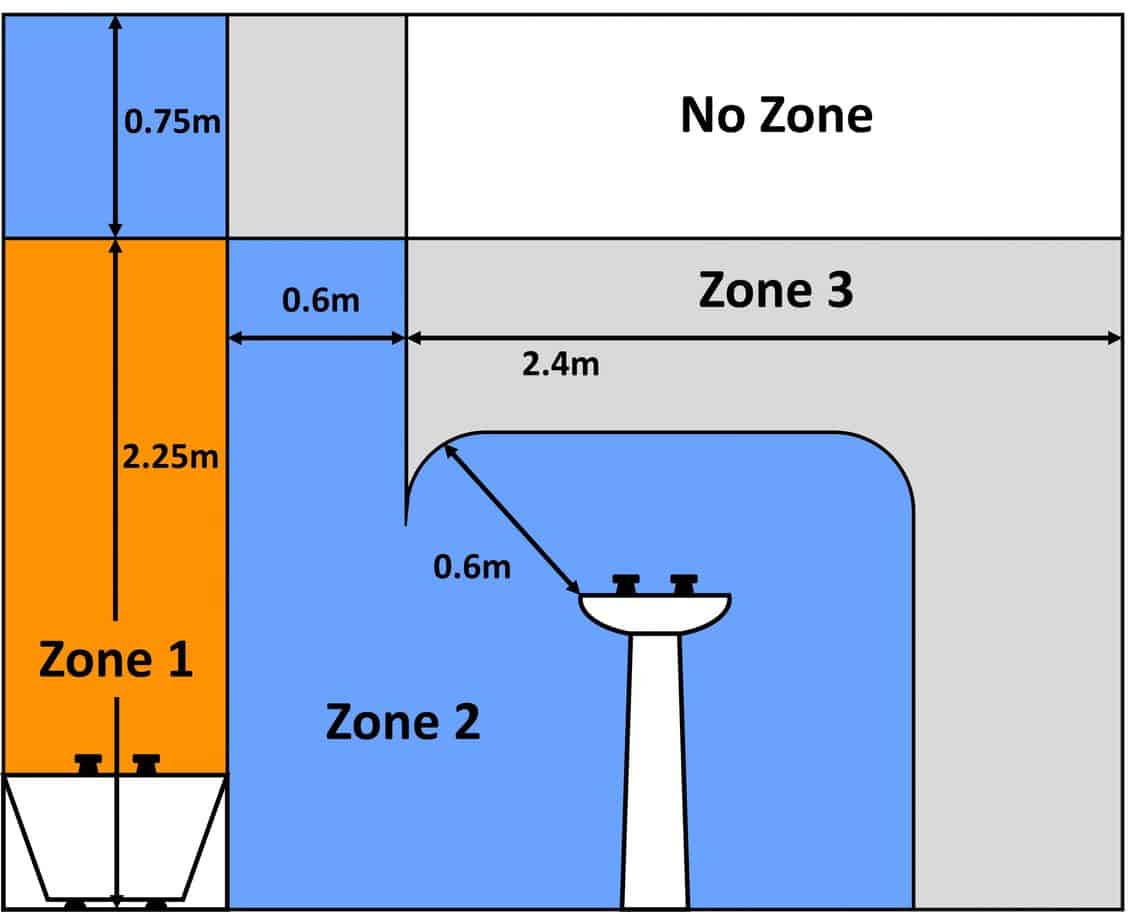
Electrical Safety in bathrooms divides into four zones.
In Zone ‘0’ which defines being within in the sink bowl, bath tub or shower bowl any electrical appliance must be IP67 (full immersion capable) and low voltage.
Zone 1 is the splash zone above a bath or within a shower enclosure and extends from the floor to 7’5″ up the walls. For a shower this zone is defined by the shower cubicle, but for a wet room (no shower cubicle and no foot bowl) this zone extends 3’11” either side from the shower source and 7’5″ upwards from the floor. Any electric appliance operated in this zone must have a 3 ma RCD protection on the circuit and IP65 or above is recommended. Note however the space above 7’5″ is “No zone” and so an IP44 Infrared panel heater can be placed above these zones e.g. on the ceiling so long as this is more than 7’5″ from the floor above a Zone 1.
Zone 2 is a 2ft safe zone outside Zone 1 to which the IP44 minimum rule applies.
“No Zone” is any other area in which theoretically no ingress protection need be applied.
All electrical appliances in a bathroom should be protected with a 30 ma RCD (Residual Current Device).
This means that any Herschel panel heater may be installed above zones 1 and can be installed within Zone 2 or “No zone”. If you are seeking to install an Advantage or Aspect space heater, please seek the advice of your Herschel Installer, since IP ratings vary.
Please visit our Customer Service section to get new copies.
Herschel panels radiate far infrared heat through the air which is then absorbed by objects and surfaces of the room. The most effective place for you to mount your panels is usually higher up on the walls or on the ceiling.
The heaters will be less effective if they are mounted directly opposite a window or door as there will be no thermal mass to absorb the energy.
You will feel heat from the panels to a distance of around 5-10 feet, so if you want to have the feeling of the warmth from the panels try to mount them within 10 feet of where you are normally located within the room.
We recommend you contacting us or one of our authorised distributors, installers or re-sellers for more advice.
The wires can be chased into the wall and completely hidden or else discretely fitted within cable trunking, in much the same way as you would do when installing any electrical device (i.e. a wall mounted flatscreen TV). Please consult your electrician or a Herschel Accredited installer for more advice.
Herschel Infrared panels are easy to install and come with a very comprehensive set of instructions. As Infrared panels are an electric installation, they should only be carried out by a suitably qualified electrician. Herschel has a network of Accredited Installers who would be happy to help you.
Things to consider when planning to install an infrared panel are:
- Provision of a suitably-sized electrical source. If you are unsure, seek your electrician’s advice;
- Locate the panel according to operating heights and minimum separation distances specified in the instruction manual;
- Ensure enough strength exists in the wall / ceiling where you are going to hang the heater;
- Follow any other precautions listed in the instructions.
Installation hardware and guides for measuring and installing the mounting brackets are included in the box with the heaters. Instructions are also always available for download from the website.
This makes Infrared significantly easier to install than oil or gas boilers, heat pumps, underfloor heating etc and implies only minor disruption to your house.
Controls Questions
Herschel thermostat controls have been designed to be easy to set up and run however sometimes we all need a bit of help and support. Our thermostat controls help centre has been designed to quickly & simply guide you to the correct support, with a few simple clicks, enabling you to resolve your query in the most convenient way. If you still require help after completing the online guidance, please fill out the Support Form within the help centre and one of our technicians will be back in contact.

In order to emit far infrared at the right waveband, our heaters are either “on” or “off” (it is not possible to vary the temperature of the heater itself). So some kind of controller is needed with your infrared panel.
We do not build thermostats into our heaters because it is the temperature of the room that is important to your sense of comfort. Built in thermostats tend to over-read the heater temperature and under-read room temperature because the close proximity of the thermostat to the heater means that it is impossible to correctly measure the room temperature. So we do not believe built-in controls are so effective plus using built in controls leaves little choice for integration into other control systems and whole building control systems.
Herschel offers the Herschel iQ controls system for Inspire panels; heater control solutions especially designed to control Herschel Infrared heaters. Precise room by room control from wherever you are, providing you with optimum comfort levels whilst minimising your energy consumption.
Herschel control systems conform to the EU Eco Design Legislation (also known as LOT 20), granting you up to 8% more efficiency.
Orders & Deliveries
Herschel Infrared is closely monitoring the development of COVID-19 during these uncertain times.
Courier Services
We continue to monitor responses from our couriers to assess the impact on courier services for customers. Please be advised that there are likely to be delays to our normal delivery levels and our Logistics team will update you on these upon order. Please contact us for more information, as required. FedEx continue to operate services. There is the potential for delays to arise however they are doing their best to limit these. As above, please contact us if you require further details.
Herschel Services
The well-being of our staff is our highest priority. Remote working is possible for nearly all our employees, and we have already taken the necessary steps to transition to this, with the majority of staff now remote working. All departments are still available as normal via phone, email or our online chat facility. We continue to remain committed to deliver the levels of service that you would expect and that we are proud of. Please bear with us if there are delays to our courier service during this unprecedented time. We will monitor developments on a daily basis and advise of any changes to our operations as soon as possible.
We would like to take this opportunity to share our wishes with everyone to stay safe and well.
There may be delays to the usual delivery timescales over the Christmas period. Please contact us for more details on +44(0)1473 760059.
Delivery times vary by product, with the majority typically taking 10 to 14 days from point of order, when in stock. See below for details on each product range:
- Inspire Comfort White Panels – 10 to 14 days
- Inspire Mirror, Glass, and Blackboard – 4 to 6 Weeks (made to order in Germany)
- Inspire Personalized Picture Panels – 5 to 6 weeks (made to order in Germany)
- Hawaii Wave – 2 to 3 weeks
- Malibu 2kW – 10 to 14 days
- Manhattan 3kW – 10 to 14 days
- Summit 2600 Black/White – 10 to 14 days
- Aspect XL – 10 to 14 days (240V); 5 to 6 weeks (120V)
- Pulsar Black/White – 10 to 14 days
- Advantage IRP4 – 10 to 14 days
- MD2 Mains Thermostat – 10 to 14 days
- Accessories – 10 to 14 days
Each product page will clearly display the current availability stock. Contact Herschel if you’re unsure if an item is in stock.
Pre-order dates represent our best estimate for when the product will be back in stock and available for dispatch, please note that we cannot guarantee these dates and they are subject to change.
You can track the status of your deliveries here.
You will be advised at the time of ordering if there are any changes to our standard lead times.
Panels are to be signed for ONLY if there is NO damage to the packaging on delivery. If there is any damage to the packaging please do not sign for the goods. Contact Customer Services at Herschel, +44 (0)1473 760059, within 24 hours of receipt to notify us of the problem. Please quote your order number in all correspondence.
Functional & Technical
Can I paint the panels so they match the same colour as my walls?
Our best advice, following testing in-house, would be to use heat resistant paints such as radiator paint. Normal emulsion doesn’t bond very well (you can easily scratch it off).
Please note, we are unable to give any warranty around the paint itself and so any discoloration of the paint is at your own risk.
There are some disadvantages to infrared heating panels compared with other forms of heating, but these are far outweighed by the many advantages.
The main consideration is that the infrared heating panels must not be obstructed by furniture. Infrared heating panels radiate invisible light (which carries the heat). If they are obstructed, for example by placing a sofa immediately in front of the panel, the heat will be absorbed by the sofa which will prevent it from heating the entire room. Infrared panels perform much better when either ceiling mounted or mounted at picture level on walls.
The other thing to be aware of is the surface temperature. Herschel infrared heating panels have surface temperatures of around 185-212°F. This makes them hot to touch. Care needs to be taken when mounting the heaters to ensure that they are located away from any vulnerable people such as young children and the elderly. Again, mounting at picture height or on the ceiling is preferable. Some suppliers offer low surface temperature heaters calling them Infrared panels – these are NOT genuine infrared heaters (see this FAQ for the correct standards) as they will mostly convect heat and will perform no better than standard electric heaters.
This depends on the ambient temperature and the levels of insulation of your building. Herschel Far Infrared heaters work by warming up the thermal mass of the room and on initial start up, this may take several hours and in some cases days, depending on the area to be heated (a damp basement room for example). It is very important to go through this phase to warm the thermal mass of the room for the heaters to work efficiently – cold walls and floors will not give occupants a feeling of warmth and wellbeing. For the system to work effectively all surfaces in the room should be at the same comfortable temperature and will start radiating back.
We recommend leaving the heaters on constantly until the room reaches the desired temperature. They then work most effectively by “topping up” the temperature using a thermostat control, being operated on a timer or a combination of both.
Herschel heaters can deliver energy-savings up to 60% over traditional heating systems.
Providing warmth 24×7 at a fraction of the cost of gas, oil, or other electric heating, infrared warms the fabric of the building – and not the air – which is the key to its energy efficiency.
100% of the electrical energy used by infrared systems is converted into heat. Infrared heaters offer owners an unprecedented level of control over their property’s temperature and energy use.
The amount will depend on each particular house or building and your previous heating solution however it has been proven that a sufficiently insulated building, fitted with infrared panels, can expect significant reductions in energy usage, including:
up to 30% reduction on gas central heating systems;
up to 50% reduction on oil central heating systems;
up to 60% reduction on electrical storage heating.
There are no maintenance and servicing costs related with Infrared heating panels.
There are no moving parts or liquids or gases that require any form of annual maintenance contract. The other major benefit of Infrared panels is that in the rare case one should go wrong, you only need replace the one that has gone wrong and don’t lose heat from the entire system (unlike central heating boilers, heat pumps, biomass).
Typical annual maintenance contracts of other heating solutions are*:
- Gas Boiler – $150 p/a
- Reversible Air conditioning – $180 p/a
- Air-water heat pump with zone controls – $290 p/a
- Biomass boiler $540 p/a
(*Average data from manufacturer and installer websites).
We could get really geeky on this but will try to keep it simple…
Herschel Inspire panels convert electricity to emit radiant heat called “far infrared”. Surface temperatures of the Inspire average 100 degrees centigrade and are designed to gently warm people and buildings.
Herschel Advantage IRP4 and Aspect XL range utilise ceramic plate emitters containing nickel wire cores.
Herschel Far Infrared emitters emit in the spectral range of 3 – 10 microns with no light at all.
The Herschel Advantage and Aspect Space heaters have surface temperatures of around 750 degrees Fahrenheit and have a higher throw and spread to heat larger areas.
The majority of the heat produced from all of our panels is “radiant”, meaning the energy is used to directly heat objects and not the air.
Modern immersion heaters and well-insulated cylinders provide a simple and fast means to raise, and store, hot water. Thermostat controls ensure the heater is cost-efficient to run.
If you have solar PV you can divert surplus solar electricity to an immersion circuit, rather than sell to the grid. This does NOT effect your 50% deemed export payment. Products such as immerSUN, Power Diverter and Solic 200 are well proven and widely available.
You can also use these devices to divert surplus solar electricity to your infrared panels, if they run on a dedicated circuit. This works best with up to 3kW of heater panels (assuming you have a 4kWp solar PV system installed).
Herschel Far Infrared emits the biologically most significant Comfort Heating wavelengths because skin content is 80% water which absorbs heat most efficiently from wavelengths of 3 microns and lower (Far Infrared). Far Infrared is better absorbed by the skin, is less transmissive (passes through) and is less reflected.
Infrared wavelengths themselves are divided into 3 distinct categories, due to the different physical characteristics of each wavelength.
“Near Infrared”, “IRA”, “Short wave” or “Bright” Infrared heaters and “Heat Lamps” operate between 780 nm to 1,400 nm and emit temperatures of 2370°F and more plus a certain amount of “deep red” visible light. Applications of this technology include heat lamps for food preparation; large volume “Space” heating requirements and certain carefully controlled medical applications.
“Medium Infrared”, “IRB” or “Medium Wave “ infrared heaters operate between 1,400 nm and 3,000 nm and emit temperatures in the high hundreds of °F. Middlewave is valuable for Space heating in cold locations or where there is a lot of airflow due to its more transmissive properties over Far Infrared.
“Far infrared”, “IRC”, “Long wave” or “Dark Radiators” operate in the wavelengths above 3,000 nm. Far Infrared elements emit much lower temperatures, typically around the 210°F mark and no visible light. This is the wavelength used in domestic “comfort” heating and Infrared Sauna applications.
“Far Infrared” is consequently the only applicable technology for a “comfort” heating application.
Please also see FAQ on Are there any standards governing Far Infrared Panels?